Types of C-section stitches and how they affect your scar recovery
- Scarban C-Section
- 17 Apr 2025
-
views
2572

Just had a C-section and wondering how your stitches affect healing and scarring? You're not alone. Many mums are unsure what type of stitches they had, how long they take to dissolve, and what they can do to support better scar results. In this guide, we explain everything you need to know, backed by clinical guidelines and expert advice.
What are C-section stitches and why do they matter?
After a caesarean birth, doctors close the wound in several layers. This includes internal stitches (in deeper tissues and muscle) and external stitches (at skin level). These sutures don't just hold your body together, they directly affect how your C-section scar form.
According to the International Clinical Recommendations on Scar Management, careful wound closure and early scar care are critical in preventing abnormal scarring.
Different types of stitches used in C-section recovery
Doctors may use several methods depending on your situation:
Dissolvable stitches (absorbable sutures)
These are the most common. They are used for internal closure and sometimes for skin level closure. They break down naturally in the body over 6–8 weeks.
Non-dissolvable stitches
These are removed manually after 5 to 7 days. Some clinicians prefer these stitches for high-tension wounds or if healing needs to be closely monitored.
Staples or skin glue
In some hospitals, metal staples are used for skin closure. These are fast to apply but may be associated with a higher risk of visible scarring. Therefore, they are rarely the first choice. Their use is typically limited to situations where speed is a priority.
The type and placement of sutures affects your healing time, risk of wound complications, and long-term resulting scar quality.
What to expect from the healing process and stitch care
Your stitches need time, support, and care to heal properly. Here’s what you can do:
- Keep the wound clean and dry. Wash gently with mild soap in the shower and carefully pat dry.
- Avoid pressure or friction. Wear soft, high-waisted underwear and avoid tight clothing.
- Don’t pick at scabs or knots. If a stitch appears at the surface, don’t pull. Ask your healthcare professional for advice.
- Watch for infection signs. Redness, pus, fever or unusual pain are warning signs, get medical help.
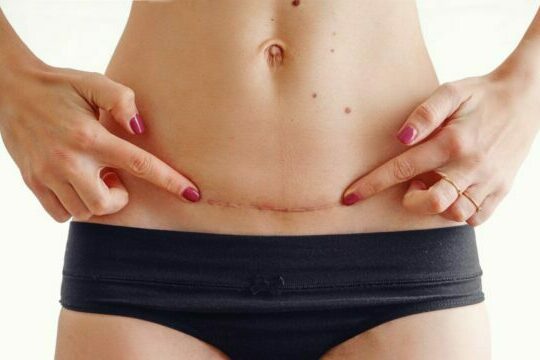
In most cases, stitches do their job quietly and efficiently. But occasionally, complications can arise:
- Wound reopening: This can happen if there's too much strain on the wound, often from lifting something heavy or moving too soon.
- Infection around the stitch line: Signs include redness, swelling, pus, or increased pain. Always contact your healthcare provider if you suspect an infection.
- Internal stitches causing discomfort: Sometimes, deeper stitches can irritate surrounding tissue, leading to ongoing pain or a pulling sensation.
How stitch complications influence your scar
When stitches do their job properly and support smooth wound healing, they help your body create an even, soft scar. But if problems occur, like infection, wound reopening, or delayed healing, your skin may start to overproduce collagen. This increases your chance of a hypertrophic or keloid scar, which is raised, thick, and often red or itchy.
These types of abnormal scarring are more likely to develop when:
- Healing is delayed or complicated (infection, tension on the wound)
- You have a personal or family history of keloids
- You have darker skin (Fitzpatrick type IV–VI)
“Wound healing complications such as infection and tension are the most important triggers for the development of abnormal scarring.”
— Mustoe et al., International Clinical Recommendations on Scar Management (2002)
Early detection and action can reduce the risk, as even minor stitch issues can influence how your scar looks months later.


How Scarban C-section helps prevent abnormal scars
Early intervention with silicone therapy has been clinically shown to reduce the risk of hypertrophic and keloid scars. Once your wound is fully closed, stitches have been removed and any scabs have fallen off, you can begin using Scarban C-Section sheets to support healthy scar formation.
These medical-grade silicone sheets are specially shaped to fit the curve and location of C-section scars, making them both comfortable and effective for daily use. Clinical research supports silicone as the first-line, non-invasive treatment for preventing and treating raised, thick, or itchy scars.
Scarban C-Section helps to:
- Hydrate the skin and regulate collagen production
- Flatten, soften and fade raised scars over time
- Reduce redness, itching and tightness
- Protect the scar from friction caused by clothing
While Scarban does not treat complications like wound reopening (dehiscence) or infection directly, these issues can increase inflammation and tension in the scar area, both of which raise the risk of abnormal scarring.
Once the wound is fully closed, silicone therapy can play a key role in managing these effects and helping the scar heal as smoothly as possible.

Final thoughts
Your C-section stitches are more than just a step in surgery, they are the foundation of how your body heals. By understanding the types of stitches used, caring for them properly, watching for complications, and supporting scar healing with medical-grade silicone sheets for scars, you give yourself the best chance at a healthy, smooth recovery.
References
-
Mustoe, T.A. et al. (2002). International clinical recommendations on scar management.
-
Niessen, F.B. et al. (1999). Topical silicone sheet application in the treatment of hypertrophic scars and keloids.
-
Anthonissen, M. et al. (2016). The effects of conservative treatments on burn scars: A systematic review.
-
Meaume, S. et al. (2014). Management of scars: updated practical guidelines and use of silicones.